
What Packing Strategy Actually Holds Up When the Weather Turns?
Let’s be real — moving day almost never goes exactly as planned. One minute it’s sunny, next thing you know you’re dealing with humidity, sudden rain, or that sticky Florida air that creeps into everything. We’ve seen it hundreds of times. And here’s the question clients rarely ask (but should): is your packing actually built for weather, or just built to be fast and cheap?


Most moving companies lean on flat-rate packing approaches. Sounds convenient, right? Fixed price, standard materials, quick execution. But in our experience at ABA Movers, that “one-size-fits-all” method often ignores the biggest variable of all — unpredictable weather and that’s where things start going sideways.
Flat-Rate Packaging vs Reality: Where Standard Methods Fall Short
Flat-rate packing isn’t inherently bad — it works fine in controlled conditions. But here’s the issue: it assumes every move is the same.
In practice, that’s just not true.
Typical flat-rate packing includes:
- Standard cardboard boxes
- Basic wrapping (paper or thin plastic)
- Minimal sealing or layering
- Speed-focused execution
What’s missing? Adaptation.
From what we’ve seen on real jobs, this approach struggles when:
- Rain hits mid-loading
- Humidity builds up inside boxes
- Temperature shifts affect materials (especially wood and electronics)
We’ve personally handled moves where poorly packed furniture absorbed moisture within minutes. Warped wood, damp couches, electronics at risk — all because the packing wasn’t designed for the environment.

Weather Risks Most People Seriously Underestimate
A lot of clients think: “It’s just a little rain.” But the damage doesn’t come from the rain itself — it comes from how materials react to it.
Here’s what actually happens:
- Moisture penetration → cardboard weakens, boxes collapse
- Humidity buildup → fabrics absorb moisture, leading to odors or mold
- Temperature swings → wood expands, electronics get condensation
- Transit exposure → items go from AC → heat → rain in minutes
And the worst part? Damage often shows up after the move.
How ABA Movers Packs for Real Weather Conditions
We don’t pack based on assumptions — we pack based on conditions. That’s a big difference. Our weather-ready packing strategies are built around one idea: layered protection + flexibility.
Here’s what that actually looks like on the job:
1. Moisture-Resistant Materials
We use thicker wraps, sealed plastic layers, and reinforced boxes designed to handle humidity — not just hold items.
2. Layered Packing System
Instead of one wrap → done, we go:
- Inner protection (padding or paper)
- Moisture barrier (plastic wrap)
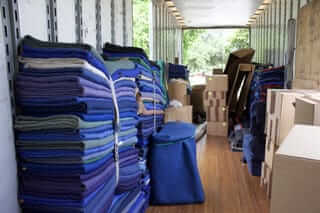
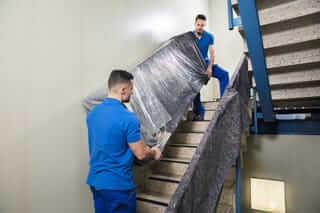
- Outer reinforcement (sealed box or blanket)
3. Item-Specific Handling
Not everything gets the same treatment:
- Electronics → sealed, insulated, minimal exposure
- Wood furniture → wrapped to prevent expansion damage
- Fabrics → breathable but protected (to avoid trapped moisture)
4. Real-Time Adjustments
- If the forecast shifts — we adapt.
- Rain starting? We reinforce loading flow.
- Humidity rising? We change materials on the spot.
That flexibility is something flat-rate systems just don’t offer.
Side-by-Side Comparison: Flat-Rate vs Weather-Ready Packing
| Feature | Flat-Rate Packing | ABA Weather-Ready Packing |
| Approach | Standardized | Adaptive |
| Material Quality | Basic | Moisture-resistant |
| Protection Layers | Minimal | Multi-layered |
| Weather Adaptation | None | Real-time adjustments |
| Risk of Damage | Higher | Significantly reduced |
| Speed | Faster | Balanced with protection |
| Long-Term Value | Lower (risk of repairs) | Higher (damage prevention) |
Practical Tips If You’re Moving in Unpredictable Weather
Even if you’re not using us (though you probably should), here’s what actually helps:
- Check the forecast — but plan for worse
- Separate weather-sensitive items (label them clearly)
- Avoid overpacking boxes (they weaken faster when damp)
- Use plastic bins for valuables if possible
- Ask your movers how they handle rain — not just if
And honestly — if a company can’t clearly explain their packing strategy for bad weather, that’s a red flag.
Why Our Approach Works From Real Experience
We’ve done moves in heavy rain, extreme humidity, and those chaotic Florida weather swings. And after testing different methods over time, one thing became obvious:
- Speed alone doesn’t protect your stuff — strategy does.
- Flat-rate packing is built for efficiency.
- Weather-ready packing is built for reality.
At ABA Movers, we’d rather spend a bit more time wrapping things properly than deal with damaged items later. It’s not just about moving boxes — it’s about delivering everything in the same condition it left.

The Bottom Line: Protection Over Convenience
If you’re choosing between flat-rate and adaptive packing, it really comes down to priorities:
- Want the cheapest, fastest option? → Flat-rate works
- Want real protection in unpredictable weather? → Go weather-ready
In our opinion — and based on years of hands-on experience — weather-ready packing isn’t an upgrade. It’s what packing should have been all along. Because at the end of the day, saving a few bucks upfront doesn’t mean much if your furniture, electronics, or personal items take a hit. And trust us — we’ve seen how that story ends.